


What To Look For
The Cayman Parrot, Amazona leucocephala caymanensis, is our National Bird. Parrots feed mostly on fruits and seeds and live in our woodlands and mangroves. Parrots nest in holes in trees, especially old trees. They are an endemic sub-species.
Silver Thatch Palm: The Coccothrinax proctorii, our National Tree is found throughout the entire Botanic Park, and was traditionally important in the early days where the silver thatch rope was highly coveted for its strength and durability.
Banana Orchid: Cayman’s National Flower, Myrmecophila thomsoniana var. thomsoniana is found through the entire Botanic Park and typically blooms in late May through June.
There are four varieties of snakes native to Cayman. All are non-venomous, the most common being the Cayman Racer. There are also land crabs, lizards, geckos, frogs and other small reptiles.
The Northern Flicker, called locally Black Heart, is a Woodpecker. It drills for ants and termites and has a typical woodpecker laugh. A wik, wik, wik call is what will draw your attention. The Black Heart nests in holes in dead trees or palms
The Blue Iguana is endemic to Grand Cayman and is an endangered species.
The Stripe-Headed Tanager is a small fruit-eating woodland bird that is usually heard before it is seen, as it makes a tweep, tweep call. It is also an endemic subspecies.
The Grand Cayman Bullfinch: Common in the park, but not elsewhere. Although Grand Cayman is home to several endemic subspecies, this is the only endemic species of bird still in existence (the Grand Cayman Thrush is now extinct.)
The Yucatan Vireo has a limited range (eastern Yucatan, offshore islands and Grand Cayman) and has a distinct call of "Sweet Bridget" which is also its local name.
Our small yellow Bananaquit is quite a common sight in Cayman. It's a very active little bird, chirping as it flits through the bush, feeding on nectar, berries, and insects.
Caribbean Dove: An endemic subspecies locally called "White Belly" because of its pale abdomen. This stocky dove has pink legs and feet and a mournful coo.
Zenaida Dove: A beautiful cinnamon-brown dove with 6-8 black spots on its wings and purple iridescence on the side of its neck. Some people claim it says "Moses preach God's Word" in a monotone coo.
Blue Throated Anole an endemic species commonly seen in the park. Interestingly, there are two distinct variations between the western and eastern districts of the island. They are able to change colour from green to dark brown or beige (hence their local name “chameleon”).
- Please note: No dogs or pets of any kind are allowed in the Park. Feeding blue iguanas or any other wildlife is not permitted. No sporting games are permitted within the QEIIBP.
Attractions To See
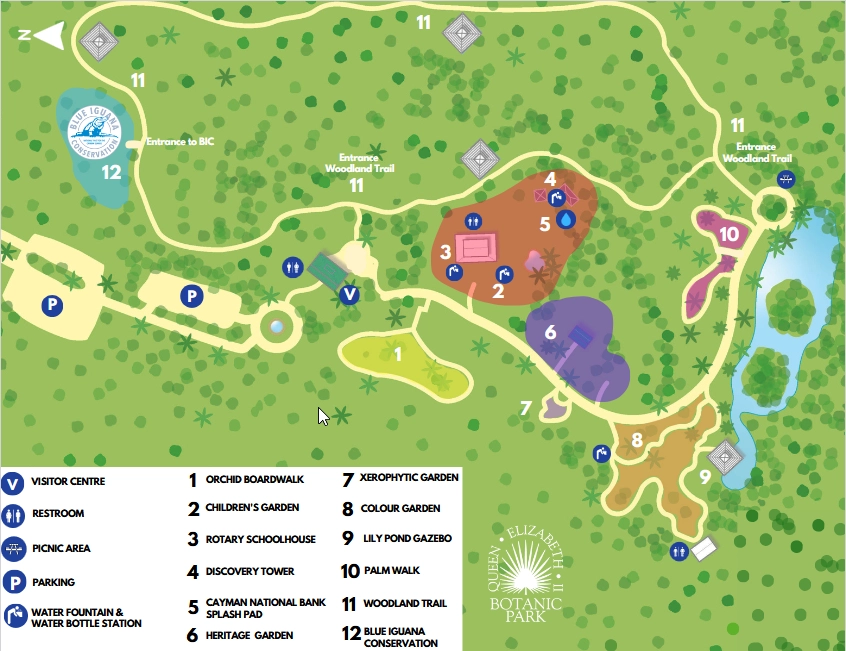
Visitor Centre: Here you can find the Admissions Area, Public Restrooms, Gift Shop and Administrative Offices.
Woodland Trail: With the main entrance located directly behind the Visitor Centre, this looping trail offers an opportunity to view the native forest, multiple ecosystems, and is the main path to the Blue Iguana Conservation Facility.
Blue Iguana Conservation Facility: See the endemic blue iguanas, that once were on the brink of extinction, up-close and personal in their semi-wild habitats. Take photos at the blue iguana mural and learn fascinating facts about the blues. Speak to our wardens to learn more about the National Trust for the Cayman Islands, Blue Iguana Conservation Programme. While walking through the park you may come across a blue iguana, please do not feed them.
Children's Garden: A newly created garden area which provides ample opportunities for both structured learning in the Rotary Schoolhouse, or passive play in the giant bird nest’s where the children can sit back and wonder how birds create their nests. An edible maze, Discovery Tower, Observation Pond, Cayman National Bank Splashpad, Toddler Zone, multiple climbing structures, and many more features make this garden unique in the Cayman Islands. A healthy place for children to learn, discover and be one with nature, with no screen time requirements!
Orchid Boardwalk: A 600ft in length, looping boardwalk where hundreds of orchids can be found amongst the native vegetation.
Heritage Garden: With a restored Caymanian House as its centerpiece, the area showcases how life was at the turn of the century in the Cayman Islands.
Xerophytic Garden: This garden exhibits plants that have evolved to survive harsh environmental conditions, and possess xerophytic qualities.
Colour Garden: Designed as a series of gardens arranged by colour, this area presents blooms throughout the year. A pathway in the white garden leads to a lovely shaded gazebo overlooking the lilypond and waterfall.
The Lake and Wetland: Situated on the edge of a Buttonwood Swamp, this seasonally flooded area provides a great opportunity to view many of the native birds of the Cayman Islands, as well as the many migratory birds that pass through our region.
Friends of the Botanic Park: Members of the Friends enjoy benefits such as; unlimited entry to the Botanic Park, 10% discount in the gift shop, members' only events and more. Please inquire at the Gift Shop.
Restrooms: Are located at the Visitor Centre, Children’s Garden Rotary Schoolhouse and in the yellow section of the Colour Garden.